
Featured
Senators Urge Trump Administration to Halt Deportation of Mauritanians
NNPA NEWSWIRE — Between 1989 and 1991, tensions between Arab-Berbers and black ethnic groups in Mauritania resulted in the government-led displacement, expulsion, and denationalization of over 70,000 black Mauritanians. According to Human Rights Watch, these injustices were also accompanied by a litany of other abuses, including extrajudicial executions, arbitrary arrests, torture, rape, property theft, and destruction of legal documents.


WASHINGTON, D.C. — Today, U.S. Senator Kamala D. Harris (D-CA) and Representatives Bennie G. Thompson (D-MS), Jerrold Nadler (D-NY), Zoe Lofgren (D-CA), and Joyce Beatty (D-OH) led a group of lawmakers in a bicameral letter calling on Department of Homeland Security Secretary Kirstjen Nielsen and Secretary of State Mike Pompeo to cease the deportation of Black Mauritanian nationals, who face the threat of race-based discrimination, violence, or slavery if forced to return to Mauritania.
“Most Mauritanians in the United States arrived here seeking refuge from government-led racial and ethnic persecution and extreme violence,” wrote the lawmakers. “For the following two decades our government declined to deport Mauritanians because of the dangerous and potentially life-threatening conditions they would face if they were returned to their country of origin.”
There are approximately 3,000 Black Mauritanians in the United States, most of whom arrived in the 1990s after their government forcibly expelled them and stripped them of their citizenship on the basis of their race and ethnicity. So far in fiscal year 2018, the Trump administration has deported 79 Mauritanians, up from eight in FY 2017.
The lawmakers continued, “Mauritanians deported from the United States face unacceptable threats of racial and ethnic discrimination and slavery…We ask DHS and the State Department to jointly respond within 60 days to the following questions to clarify U.S. policies and practices regarding deportations of Mauritanians.”
In addition to Senator Harris and Representatives Thompson, Nadler, Lofgren, and Beatty, the letter was signed by Senators Patrick Leahy (D-VT), Dick Durbin (D-IL), Bernie Sanders (I-VT), Ron Wyden (D-OR), Tammy Duckworth (D-IL), Sherrod Brown (D-OH), Cory Booker (D-NJ), Elizabeth Warren (D-MA), and Amy Klobuchar (D-MN) and Representatives Eleanor Holmes Norton (D-DC), Pramila Jayapal (D-WA), Bonnie Watson Coleman (D-NJ), Jim McGovern (D-MA), Alcee Hastings (D-FL), Debbie Dingell (D-MI), Yvette Clarke (D-NY), Jan Schakowsky (D-IL), Raúl Grijalva (D-AZ), John Lewis (D-GA), Colleen Hanabusa (D-HI), Adriano Espaillat (D-NY), Elijah Cummings (D-MD), Al Green (D-TX), Linda Sanchez (D-CA), Lloyd Doggett (D-TX), Nydia Velázquez (D-NY), Judy Chu (D-CA), Barbara Lee (D-CA), Albio Sires (D-NJ), Hakeem Jeffries (D-NY), Keith Ellison (D-MN), and David Cicilline (D-RI).
PDF of the letter is available here and below.
October 12, 2018
[one_half]The Honorable Kirstjen Nielsen
Secretary
U.S. Department of Homeland Security
Washington, D.C. 20528[/one_half][one_half_last]The Honorable Mike Pompeo
Secretary
U.S. Department of State
Washington, D.Cl 20518
[/one_half_last]Dear Secretary Nielsen and Secretary Pompeo,
We write to urge the immediate cessation of deportations of Mauritanian nationals to the Islamic Republic of Mauritania. Under the Trump Administration, the Department of Homeland Security (DHS) has abruptly abandoned its 20-year long practice of simply monitoring most Mauritanians eligible for removal and begun actively deporting them. Most of the approximately 3,000 black Mauritanians in the United States have been here since the late 1990s, arriving after being violently expelled and stripped of citizenship by their government because of their race and ethnicity. It is unconscionable for the United States to deport these individuals back to Mauritania, where they will likely be denied basic human rights and possibly persecuted and enslaved.
Most Mauritanians in the United States arrived here seeking refuge from government-led racial and ethnic persecution and extreme violence. Between 1989 and 1991, tensions between Arab-Berbers and black ethnic groups in Mauritania resulted in the government-led displacement, expulsion, and denationalization of over 70,000 black Mauritanians. According to Human Rights Watch, these injustices were also accompanied by a litany of other abuses, including extrajudicial executions, arbitrary arrests, torture, rape, property theft, and destruction of legal documents. Upon their arrival in the United States, many Mauritanians unfortunately failed to make successful asylum claims and became removable; some were apparently exploited by predatory immigration consultants who submitted shoddy or fraudulent materials to the U.S. government on their behalf. Nonetheless, for the following two decades our government declined to deport Mauritanians because of the dangerous and potentially life-threatening conditions they would face if they were returned to their country of origin. Those who lacked lawful status were simply required to periodically check-in with Immigration and Customs Enforcement (ICE).
Following President Trump’s January 25, 2017 Executive Order “Enhancing Public Safety in the Interior of the United States,” which suspended the issuance of visas to nationals from countries ICE identified as being “recalcitrant” to cooperate with U.S. repatriation efforts, the Mauritanian government began to issue travel documents (laissez-passer) to facilitate U.S. deportations. This shift fueled a significant escalation in Mauritanian deportations. While DHS deported just four Mauritanians in fiscal year 2015, ten in fiscal year 2016, and eight in fiscal year 2017—in contrast, seventy-nine Mauritanians have been deported in fiscal year 2018 thus far.
Mauritanians deported from the United States face unacceptable threats of racial and ethnic discrimination and slavery. The slavery of individuals of black race and ethnicity remains rife in Mauritania, where the government only first abolished slavery in 1981, and only first criminalized it in 2007. The Central Intelligence Agency estimates that 20 percent of the Mauritanian population is enslaved, the highest rate worldwide. The International Labour Organization has “expressed deep concern over the persistence of slavery on a widespread scale” in Mauritania. The United Nations has noted that a “lack of access to basic services and alternative livelihoods for former black African and Haratine slaves serves to propagate the belief that former slaves are still inferior and will always be slaves.” The State Department has issued a level three (out of four) travel advisory for Mauritania, a designation reserved for countries whose governments do not fully meet the minimum standards for elimination of trafficking in the Trafficking Victims Protection Act and are not making significant efforts to do so.
Political conditions in Mauritania also unacceptably threaten deportees’ civil liberties and safety. Since current Mauritanian President Mohamed Ould Abdel Aziz overthrew a democratically-elected president in 2008, Mauritanian authorities have denied the existence of slavery and begun aggressively cracking down on anti-slavery activists. They have prohibited their peaceful gatherings, broken up their protests with excessive force, and surveilled them. Human rights advocates have documented over 168 arbitrary arrests of activists by government authorities since 2014 – alleging that 20 suffered torture, including being beaten, chained, threatened with death, and deprived of food, water, and sleep. A recently deported Mauritanian alleges that he was immediately jailed by government authorities for 13 days before he was released and fled the country. The State Department broadly urges reconsideration of travel to Mauritania due to crime and terrorism, stating that “violent crimes, such as mugging, armed robbery, rape, and assault are common.”
In light of the above facts, we ask DHS and the State Department to jointly respond within 60 days to the following questions to clarify U.S. policies and practices regarding deportations of Mauritanians, specifically:
- Has the State Department’s assessment of conditions in Mauritania or of risks and dangers for deportees in Mauritania informed DHS deportations of Mauritanians?
- Do DHS and the State Department have general policies and procedures regarding deportations of individuals to nations with governments that previously expelled such individuals on the basis of race or ethnicity?
- Is there precedent for the United States to deport large numbers of individuals back to a country that has persecuted them on the basis of race or ethnicity and/or rescinded their citizenship?
- How do DHS deportations of these individuals comply with international law and statutes pertaining to the treatment of stateless individuals and other individuals who are persecuted on the basis of their race and ethnicity?
- Has DHS or the State Department coordinated with Mauritanian authorities to ensure fair and safe treatment of deportees?
- What investigation, if any, has DHS or the State Department made into claims that black Mauritanians have been arbitrarily detained by Mauritanian authorities following their deportation?
- Please provide all documentation of communications between DHS, the State Department, and/or the Mauritanian government regarding the deportation of Mauritanians since January 2017.
We thank you for your attention to this matter.










Featured
Headlines and Hotlines
Niele Anderson and Rodney Perry break down today’s hottest headlines on the BlackPressUSA Morning Show. Don’t miss the conversation behind the news!

BlackPressUSA Morning Show: Host Niele Anderson is joined by Rodney Perry for a closer look at the headlines demanding attention.
Watch BlackPressUSA Morning Show for the headlines, the context, and the conversation behind the news.
#BlackPressUSA #MorningShow #BlackNews #NieleAnderson
Featured
Headlines and Hotlines 📱
Join Niele Anderson and Rodney Perry on the BlackPressUSA Morning Show as they break down today’s hottest headlines and the conversations behind them.

BlackPressUSA Morning Show: Host Niele Anderson is joined by Rodney Perry for a closer look at the headlines demanding attention.
Watch BlackPressUSA Morning Show for the headlines, the context, and the conversation behind the news.
#BlackPressUSA #MorningShow #BlackNews #NieleAnderson
Black Press
Statement from the President of the National Association of Black Journalists on Press Ban
TEXAS METRO NEWS — The National Association of Black Journalists (NABJ) condemned President Donald Trump’s decision to deny access to MS NOW journalists and his threats against CNN and Politico due to unfavorable coverage. The NABJ stated that journalists hold power accountable for the American people, and government officials cannot grant or withhold access based on reporting they like or dislike.


NABJ condemns President Donald Trump’s decision to deny access to MS NOW journalists and his threat to exclude CNN and Politico because of coverage he dislikes. The role of journalists is to hold power accountable on behalf of the American people. Government officials cannot reward reporting they find favorable with access, or withhold access as punishment for journalists who have scrutinized or criticized them. This retaliation is a threat not only to the news organizations being targeted, but to every journalist working to report independently and without fear of government reprisal. The White House belongs to the American people, and they have a right to know what their government is doing. Journalists must be free to ask difficult questions and report the answers. A free and independent press is not a privilege granted at the discretion of any president. It is a cornerstone to a healthy and functioning democracy. The First Amendment can never be optional.
Based on reporting by Texas Metro News.
Black Press
America’s Reading Crisis Demands More Than Concern. It Demands Action.
JACKSON ADVOCATE — A national literacy crisis is emerging as reading achievement continues to decline across the United States. Nearly 40% of fourth graders read below the basic level, and roughly one-third of eighth graders are below basic, marking the highest share ever recorded.

By Marc H. Morial
National Urban League President & CEO
New York City’s troubling decline in reading scores, despite one of the most ambitious literacy reform efforts in the nation, is a wakeup call for the entire nation.
Across the country, reading achievement continues to decline. Nearly 40 percent of fourth graders read below the basic level and roughly a third of eighth graders are reading below basic, the highest share ever recorded.
Taken together, these numbers reveal a national literacy crisis that threatens economic opportunity, educational equity, and our nation’s future competitiveness.
Reading is not merely another subject in school. Reading is the foundation upon which all learning rests. A child who struggles to read struggles to learn history, science, mathematics, and civics. A young person who cannot effectively read and analyze complex information faces barriers to college completion, workforce success, and informed participation in our democracy.
That is why the growing literacy crisis is fundamentally an opportunity crisis. Behind every percentage point is a child whose future opportunities hang in the balance. Persistent achievement gaps mean that Black and Latino students continue to bear a disproportionate share of the consequences when reading instruction falls short. If we are serious about economic mobility and educational justice, literacy must be at the center of the conversation.
For more than two decades, many schools embraced Balanced Literacy approaches that sought to cultivate a love of reading by putting books in students’ hands and encouraging independent reading. The approach was well-intentioned, but too often foundational skills instruction, particularly phonics and decoding, suffered.
The evidence is increasingly clear that explicit, systematic instruction helps more children become successful readers. States and school districts that are embracing these principles deserve credit for moving in the right direction. But millions of students are already in middle school, high school, and even college struggling to read complicated texts, analyze difficult arguments, and complete entire books.
What is our plan for them?
Too many students arrive in high school lacking the reading stamina necessary to engage deeply with literature, history, or complex informational texts. College professors increasingly describe students who struggle with lengthy assignments that previous generations navigated more comfortably.
To be clear, Balanced Literacy alone cannot explain these trends. Increased screen time, constant digital distractions, shortened attention spans, and the dominance of algorithm-driven content all influence students’ reading habits and learning experiences.
Yet recognizing these factors cannot become an excuse for inaction.
Instead, it should compel us to think more broadly about literacy.
The challenge before us is not simply helping children sound out words. It is helping them develop the capacity to wrestle with complex ideas, sustain attention, evaluate evidence, and build knowledge through reading. It is helping them become informed citizens and lifelong learners.
And that requires a comprehensive, systemic strategy.
We need high-quality literacy instruction beginning in early childhood settings and extending throughout elementary school. We need to strengthen early intervention so that struggling readers receive support before learning gaps become entrenched. We must carefully examine the quality and effectiveness of programs serving our youngest learners, including Head Start and other early childhood initiatives.
At the same time, we need a national commitment to literacy recovery for older students. Districts and states should be developing evidence-based strategies that help adolescents strengthen comprehension, vocabulary, knowledge-building, and engagement with complex texts. Students who fell behind during the pandemic and those who continue to struggle deserve intensive support, not lowered expectations.
We should also have serious conversations about the role of technology in children’s lives. Restricting unnecessary screen exposure, particularly in the early grades, should be part of a broader effort to rebuild reading habits and attention spans that support learning.
More concerning than the decline in reading scores is the absence of a clear, large-scale strategy to address the growing crisis. Every year that a struggling reader falls further behind increases the likelihood that they will face lifelong educational and economic disadvantages.
The recent reading results from New York City are a warning. The national NAEP results are an even louder one. Together, they tell us that incremental change is not enough.
We know more about how children learn to read than ever before. We know that literacy is the gateway to opportunity. What remains to be seen is whether we have the collective will to act with the urgency this moment demands.
Our children cannot afford for us to wait.
Based on reporting by Jackson Advocate.
Featured
HBCU Leaders, Corporate Partners Convene in D.C. to Strengthen Support for Black Colleges’ Athletic Programs
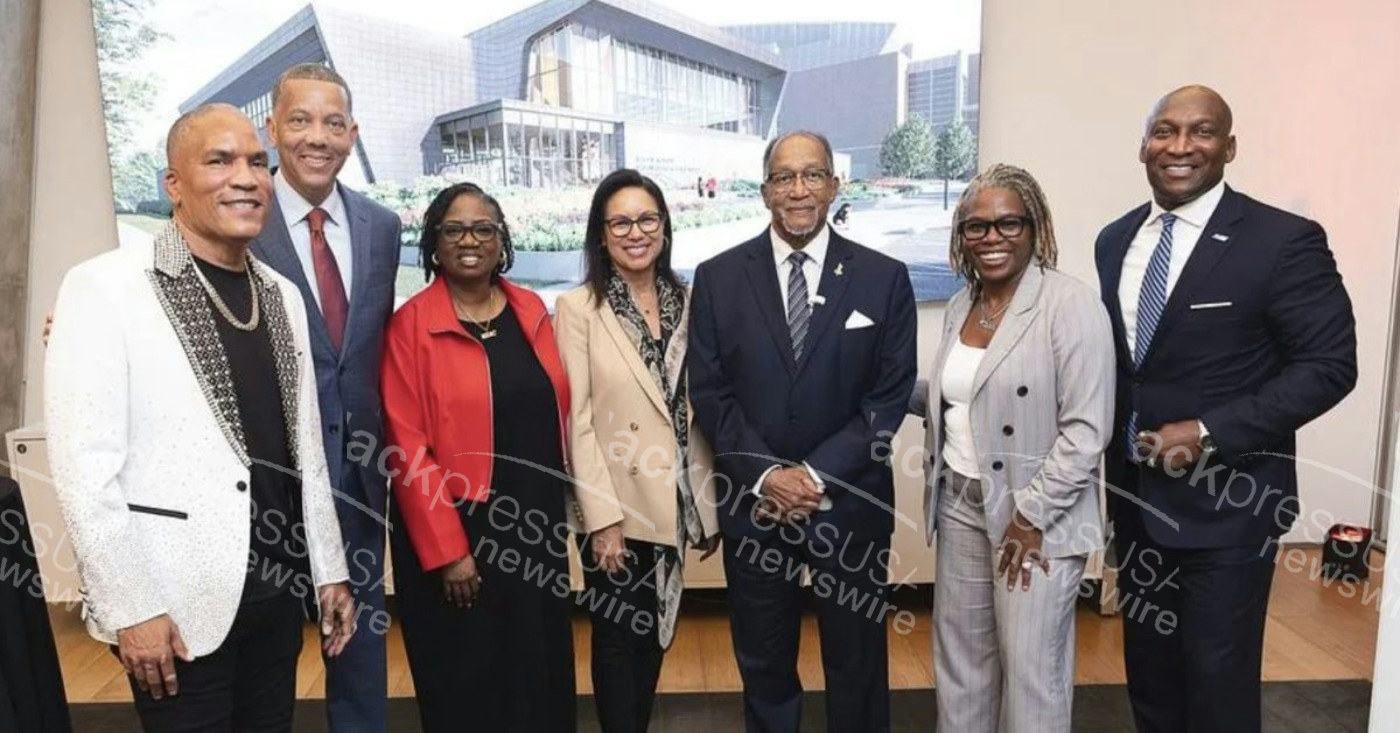
Commissioners from HBCU athletic conferences joined university presidents and corporate leaders in Washington on Tuesday, Sept. 15, for the Salute to HBCU Sports Leadership Reception — an invitation-only gathering aimed at deepening investment in historically Black colleges and universities.
Hosted at Gensler’s K Street office, the evening brought together conference commissioners, campus presidents, and executives from sports, media and design organizations under the theme “Building Partnerships. Celebrating Excellence. Advancing HBCUs.” Gensler highlighted its partnership with Paxton Baker on the event in a post on Instagram, showcasing the room full of HBCU presidents and conference leaders.
Five Conferences, One Room
Commissioners from four NCAA conferences and one NAIA conference were on hand, representing institutions that compete across Division I, Division II and the NAIA:
Anthony Holloman — Southern Intercollegiate Athletic Conference Charles McClelland — Southwestern Athletic Conference Jacqie McWilliams Parker — Central Intercollegiate Athletic Association Sonja Stills — Mid-Eastern Athletic Conference Kiki Baker Barnes — HBCU Athletic Conference
Their presence linked leadership from across the HBCU athletics landscape with campus administrators and organizations working in event management, design and media.
Presidents and Black Press Leadership in the Room
Among the university presidents in attendance were Prairie View A&M’s Tomikia P. LeGrande and Bowie State’s Aminta H. Breaux.
LeGrande’s appearance came just days after the Thurgood Marshall College Fund named her the recipient of its Educational Leadership Award, as announced by Prairie View A&M. She was honored at TMCF’s 39th Anniversary Gala on Sept. 12 in Washington. LeGrande has served as Prairie View A&M’s ninth president since June 2023.
Breaux, who has led Bowie State since July 2017, previously chaired the CIAA’s board of directors, according to her university biography.
Benjamin F. Chavis Jr., president and CEO of the National Newspaper Publishers Association, also attended — fitting, given the NNPA’s role as one of the reception’s presenting partners. Chavis and HBCU GO’s Lawrencia Moten conducted two 30-minute interview sessions with the conference commissioners, covering topics ranging from the NIL era to conference growth and the experience of leading HBCU athletics, according to HBCU GO President Curtis Symonds, who spoke with HBCU Legends about the sessions.
Corporate and Institutional Partners
Five organizations presented the reception together:
Gensler — the architecture and design firm that hosted the event Events DC — the District’s convention and sports authority USA Track & Field — the sport’s national governing body National Newspaper Publishers Association — representing Black newspaper publishers HBCU GO — the network dedicated to HBCU sports and culture
That mix of partners pointed to a range of possible collaborations ahead, from athletic facilities and event operations to sports programming and media coverage.
Building Beyond the Scoreboard
What stood out most was the mix of people in the room — conference commissioners setting strategy for their leagues, university presidents shaping institutional priorities, and corporate partners bringing resources and expertise from multiple industries.
With college athletics undergoing rapid change, particularly for HBCUs navigating the NIL era and shifting conference dynamics, the reception offered a venue for candid conversation and relationship-building. Its underlying purpose went beyond athletics: using sports as an entry point to broader opportunities in education, workforce development and economic growth for HBCUs.
Based on reporting by Columbus Times.
Art
Peter Magubane: a Camera Against Apartheid
THE POSITIVE COMMUNITY — Peter Magubane, a pioneering South African photographer, dedicated his life to documenting the realities of apartheid. Born in 1932, Magubane began his career at Drum magazine in 1954, initially as a driver before becoming a photographer.
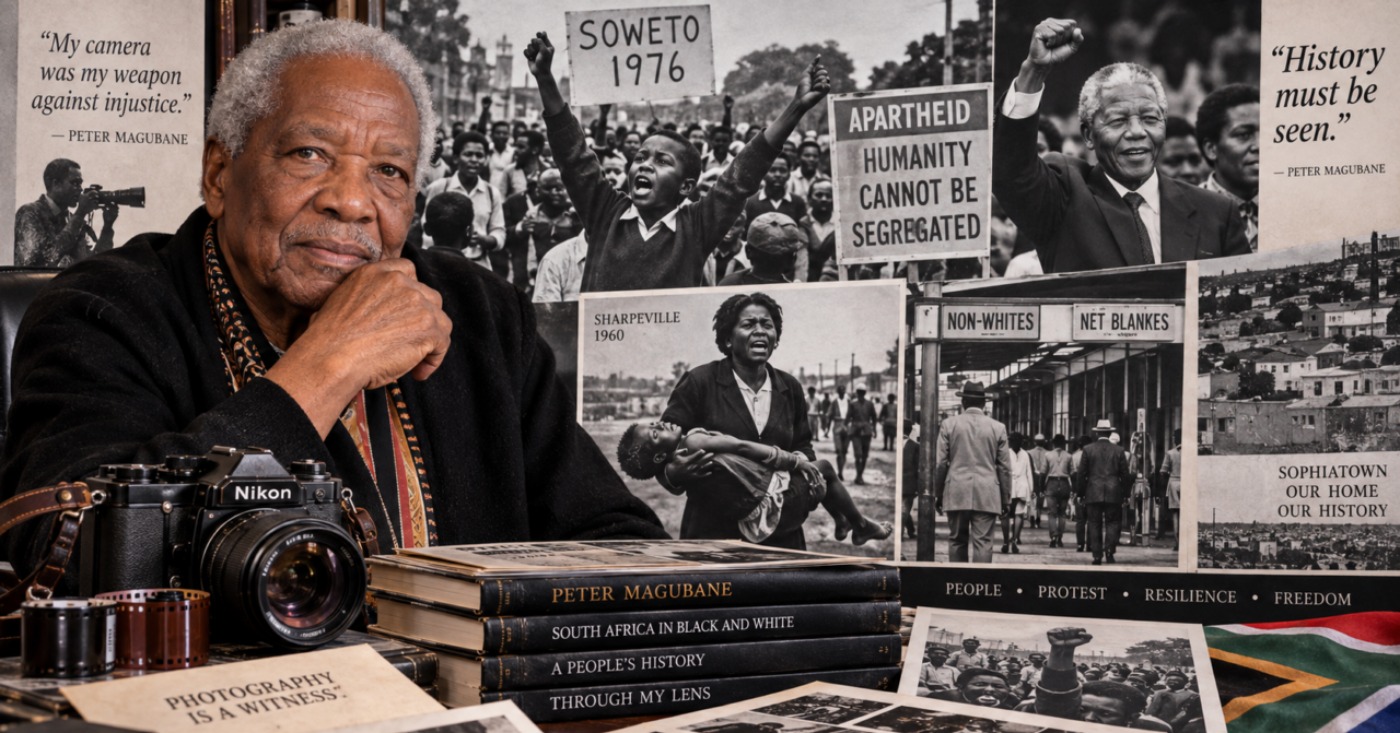
Peter Magubane was more than a photographer. He was a witness, storyteller, historian and courageous chronicler of one of the most turbulent periods in South African history. Born on January 18, 1932, in Vrededorp, Johannesburg, and raised in Sophiatown, Magubane discovered photography as a young boy after receiving a Kodak Brownie camera. That simple camera would eventually become his instrument for documenting the lives, struggles and determination of Black South Africans. He died on January 1, 2024, at the age of 91, leaving behind one of the most important photographic archives of South Africa’s apartheid era.
Magubane’s professional journey began at Drum magazine in 1954. He initially worked as a driver and messenger, but his ambition was to become a photographer. Under the mentorship of Drum’s legendary chief photographer Jürgen Schadeberg, Magubane developed his skills and began photographing major political and social events. His first significant assignment involved covering the 1955 African National Congress convention. From that point forward, photography became his way of documenting a country undergoing enormous change.
The South Africa that Magubane photographed was governed by apartheid, a system that legally enforced racial segregation and discrimination. For Black South Africans, everyday life was shaped by restrictions on where they could live, work and travel. Magubane did not limit himself to photographing politicians or famous leaders. He photographed ordinary people—children, workers, families and communities—giving the outside world a visual record of what apartheid meant in everyday life.
One of the defining moments of Magubane’s career came in 1960, when he photographed the aftermath of the Sharpeville Massacre. His photographs helped bring international attention to the violence surrounding resistance to apartheid. He also photographed the 1956 women’s anti-pass march, the Rivonia Trial involving Nelson Mandela and other activists, and numerous other events that became part of South Africa’s historical record.
Magubane paid an enormous personal price for his work. In 1969, he was arrested while photographing protesters outside Pretoria Central Prison. He was subsequently held in solitary confinement for 586 days. After his release, the apartheid government placed him under a banning order that severely restricted his ability to work and move freely. Yet the restrictions did not convince him to abandon photography. Instead, they demonstrated just how powerful the authorities believed his photographs could be.
In 1976, Magubane documented the Soweto Uprising, when thousands of Black students protested against the apartheid government’s education policies. His photographs captured young people confronting police violence and became some of the most internationally recognized images of the uprising. Despite the danger, Magubane continued photographing what was happening around him. His work transformed individual moments of protest into permanent historical evidence that could not easily be erased.
His creativity was matched by his determination to get the picture. Because authorities restricted photographers and attempted to prevent journalists from documenting certain events, Magubane sometimes concealed his camera in unusual places, including a hollowed-out Bible, bread and other objects. These methods allowed him to continue working when openly carrying a camera could attract police attention. His photographs demonstrated that documentary photography sometimes requires not only technical ability but extraordinary courage and resourcefulness.
After Nelson Mandela was released from prison in 1990, Magubane entered another important chapter of his career. He became Mandela’s official photographer and documented the transition toward democracy, including significant moments surrounding South Africa’s first democratic election and the Truth and Reconciliation Commission. The photographer who had spent decades documenting resistance now had the opportunity to photograph a country moving toward a new political era.
Magubane’s legacy extends far beyond the individual photographs he made. He published numerous books, exhibited internationally and received major honors, including an honorary Doctor of Literature from the University of Cape Town in 2010. His photographs remain part of the historical record because they show not only the brutality of apartheid but also the humanity, resilience and determination of the people who lived through it.
Peter Magubane ultimately demonstrated the extraordinary power of photography. He understood that a photograph can preserve a moment long after the people who witnessed it are gone. His camera recorded injustice, resistance, suffering, courage and eventually freedom. For photographers today, his life offers an enduring lesson: photography is not simply about making beautiful pictures—it can also be about seeing clearly, standing close to history and making sure that important stories are never forgotten. Magubane’s photographs gave South Africa a visual memory, and his life’s work reminds every photographer that sometimes the most important picture is the one that history needs someone brave enough to make.
Based on reporting by The Positive Community.


2027 Kia Seltos X Line AWD: Worth the Price? #shorts

Headlines and Hotlines

Headlines and Hotlines 📱

Easy Car Entry, Smooth Ride, Effortless Turns! #shorts

Statement from the President of the National Association of Black Journalists on Press Ban

America’s Reading Crisis Demands More Than Concern. It Demands Action.

HBCU Leaders, Corporate Partners Convene in D.C. to Strengthen Support for Black Colleges’ Athletic Programs

Peter Magubane: a Camera Against Apartheid

HBCU Leaders, Corporate Partners Convene in D.C. to Strengthen Support for Black Colleges’ Athletic Programs

At CBCF Conference, a Panel Asks What Black Public Figures Owe the People Who Follow Them

You Had Me at Hello: the Love and Legacy of Grace Nail and James Weldon Johnson

Arnold Perkins: At 85, a Life of Service, Faith and Giving Back

Young Black Men Suffering in Silence A curse that can be Broken

Young Black Men Suffering in Silence A curse that can be Broken

🎷 Jazz is taking over D.C.!

BSPNTX Announces 2026-27 Scholarships Recipients

Women Learned Their Jail Strip Searches Were Recorded. Their Outrage Changed the Law

Black Americans Have Doubts About the U.S. Food System

Barbados – Julius Garvey, Son of Marcus Garvey, Joins PM Mottley in the Rededication of the Garvey Amphitheater

Latest Massacre in Haiti Reveals Cruelty U.S. Deportations
2027 Kia Seltos X Line AWD: Worth the Price? #shorts
Headlines and Hotlines
Headlines and Hotlines 📱
Easy Car Entry, Smooth Ride, Effortless Turns! #shorts

Cannabis prohibition was rooted in racism: Jess Jackson with the MN Office of Cannabis Management

Kia Seltos: 3 Questions Before You BUY! #shorts

The Conversation With Al McFarlane (09/22/2026

LIVE! — ASK ALMA! — TUS. 9.22.26 7PM EST

The People’s Revival National Campaign Launch

Interior 2026 GMC Acadia Denali Ultimate AWD 360 Video
-
 Black History1 week ago
Latest Massacre in Haiti Reveals Cruelty U.S. Deportations
-
 Black History1 week ago
Henry O. Flipper: A Trailblazer at West Point and Beyond
-
 Black History1 week ago
OP-ED: If AI Is the New Language of Power, Then NAN Wants Black Communities Fluent
-
 Black Press1 week ago
Asm. Smallwood-Cuevas’s Bill Repealing ‘Racist’ CalWORKs ‘Man-in-the-House’ Rule Clears Legislature
-

 Black History1 week ago
OPINION: Nolan Wells’ Death One of Several Signifying Racial Terror Lives on in U.S. South
-
 Black Press1 week ago
California Legislature Sends Historic Native American Apology Bill to Gov. Newsom’s Desk
