
NNPA Special Reporting - Puerto Rico
Loíza: The Heart of Puerto Rico’s Black Culture
Black residents of the island discuss what it means to be Black or Afro-Puerto Rican on the island. NNPA Newswire Special Correspondent Tatyana Hopkins coverage of hurricane efforts in Puerto Rico.


By Tatyana Hopkins (NNPA Newswire Special Correspondent/The Washington Informer)
Samuel Lind’s two-story wooden home functions as an art gallery and studio. When he’s at home, visitors can view his overwhelming collection of work, which ranges from colorful cartoonish posters for local festivals, to life-like paintings of Black women, to serious life-sized clay and bronze statues depicting African people and deities. Themes of nature and African heritage fill the walls of the studio—and so does the Puerto Rican flag.
Several of the island’s flags hang visibly and proudly among Lind’s hundreds of paintings, because most of Lind’s work is inspired by his hometown, the small beachside community of Loíza, Puerto Rico.
Loíza is Puerto Rico’s center for African-inspired traditions and it retains one of the largest Black populations on the island; more than 60 percent of its 30,000 residents identify as Black.
“This town is very dynamic in its expressions of its Black roots,” Lind said.
African heritage can be seen all around the town—the music, dance, art and food are all deeply rooted in African tradition.
Known as the “Capital of Traditions,” Loíza is the birthplace of Black Puerto Rican music and is where the dance Plena was born. Bomba music and other African-Taino infused food and traditions are commonplace here. Loíza artisans produce the colorful coconut masks displayed at festivals and make the unique Bomba drums.
“My work identifies with Black people, because that is my reality,” Lind said.
Loíza is the home of the Saint James Festival, which is celebrated in July and depicts the battle Saint James over the Moors. The festival is known for the participation of vejigantes, caricatures of demon or bat-like figures, made of papier-mâché or coconut masks and vibrantly colored dresses, who represent the Moors.
A soft-spoken man, Lind said his art is the instrument that best describes his identity and he purposely depicts African heritage to get display its influence on the island’s culture. A giant 16-foot bronze statue designed by Lind rests in the African section of the Botanical Garden in Caguas. It depicts the Yoruba deity Osain, the god of wild plants, healing and magic, and symbolizes African roots in the island’s culture and identity.
But, he said, beyond being Black, the people of Loíza are also Puerto Rican.
“The principle is we’re Black, and people here are very clear that they are African descendants,” Lind said. “In the United States, you see Black and White more clearly, but not here.”
Many residents in the town express pride in their African origins, as well as their Puerto Rican roots.
“Afro-Puerto Ricans have to look at themselves through the context of being Puerto Rican, because we are not straight up African,” said Maricruz Rivera Clemente, founder of the Pinones Integration Corp. Clemente founded the organization in 1999 to bring awareness to social issues affecting the island’s Black communities. “[Most] people understand that some aspects of our heritage are Black, but some people choose to deny it.”
Rivera Clemente continued: “We are working to educate people about ‘our blackness,’ but not just that we are African, but also about,” our Puerto Rican heritage.
Pinones Integration Corp. offers educational activities centered on community development and economic development, bike and kayak rentals, as well as Bomba and Plena dance classes. Pinones’ Bomba dance troupe, Black Majesty, has performed on stages around the world including New York, Cuba, Tanzania and Zanzibar.

[/media-credit] Raul Ayala (left) and his sister run the nearly sixty-year old family-owned souvenir shop and Bomba dance troupe began by their father Castor Ayala in Loíza, Puerto Rico. (Tatyana Hopkins/NNPA)
“We, the Puerto Ricans, are three different races—Spanish, [Taino] Indian and African,” said Raul Ayala, son of master artisan and founder of the Hermanos Ayala folkloric ballet, Castor Ayala.
Raul Ayala runs the family’s famous yellow souvenir shops, known for its vejigantes, the colorful coconut mask worn in festivals; His father opened the shop in 1959.
“Only Puerto Rico has Bomba and the town of Loíza kept it alive,” said Ayala, adding that years of separation from the rest of the island allowed Loíza to maintain its unique culture.
Ayala said that the more developed neighboring city of Carolina was like Loíza, until local investment and development changed the town.
“Different types of people moved in and changed the composition of the town,” said Ayala.
Loíza only recently became easily accessible to the rest of the island. Before a highway was built in 1970 to connect the historic tropical town to neighboring cities across the Río Grande de Loíza, it could only be accessed by ferry.
This separation helped the town maintain its cultural roots, but also cut it off from development. Loíza gets its name from a Taino female chief, Yuiza, who chose the name “Luisa” after being baptized by the Spaniards. It began as a place to harbor escaped slaves from Puerto Rico and all over the Caribbean. But, despite its rich culture, Loíza is one of the most impoverished parts of Puerto Rico.
Only 20 minutes east of the capital San Juan, Loíza is often overlooked as a tourist destination, even though resorts lie 5-10 minutes east of the river in Rio Grande.
“That’s not a coincidence,” said Mara Clemente, a Loíza resident. “People in Loíza don’t put their address on job applications; they say they are from Carolina or Rio Grande.”
Clemente said that many people on the island do not address forms of institutional racism on the island.
She said that, because of its large Black population and bureaucratic racism, Loíza has been left out of the island’s development compared to neighboring towns on the island. Nearly 50 percent of the residents in Loíza live under the poverty line and the town’s unemployment rate is almost triple the national average.
“What makes Loíza any different from any other Black ghetto?” Clemente asked. “Africans all over the world must reach out to each other to change this.”
Clemente said that she often feels alienated for her bold views on race.
“I am not an Afro-Puerto Rican,” she said. “I am an African in Puerto Rico.”
She hopes to create a Pan-African library in the town.
Some residents report negative stereotypes about Loíza, often referred to as “that Black town,” because of its high crime rate, while others contend that race relations on the island are improving.
“Racism is not bad here, but we are conscious of race; some people are racists, but some are not,” said Carmelo J. Carrasquill, 17, who identifies himself as Black. “Race is important, but we don’t care about that as much, because we are all Puerto Rican.”
Tatyana Hopkins is a staff writer for the Washington Informer, who recently traveled to Puerto Rico to report on the hurricane recovery efforts for the NNPA Newswire and BlackPressUSA.com. You can follow Tatyana Twitter @tat_hopkins.










Featured
After Hurricane Maria, Superior Vocational High School in Loíza Makes Slow Progress
After Hurricane Maria, recovery efforts have been slow at Superior Vocational High School in Loíza, Puerto Rico. NNPA Newswire Special Correspondent Tatyana Hopkins reports on Hurricane Maria’s impact on education across the island.
By Tatyana Hopkins (NNPA Newswire Special Correspondent)
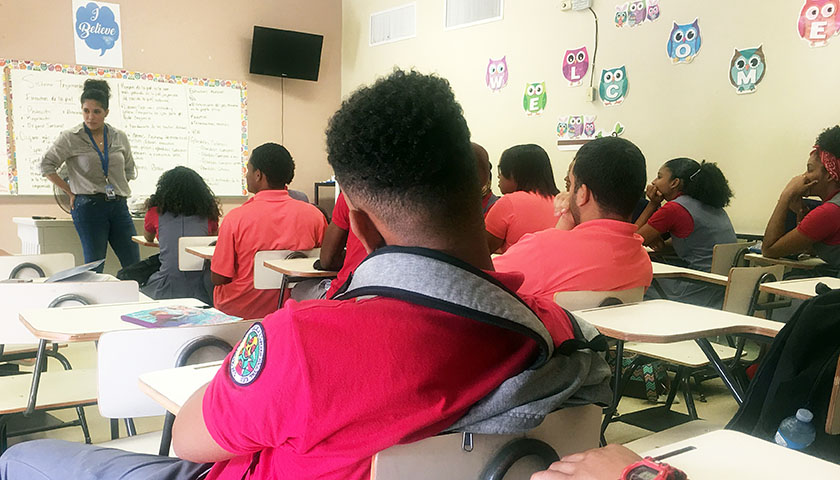
LOÍZA, Puerto Rico—Thousands of students in Puerto Rico have settled back into classrooms after Hurricane Maria ripped through the island in September, knocking out electricity to the island and closing all of its 1,100 schools.
But, reopening the schools once used as shelters and community centers in the storm’s aftermath has proven to be a small step towards normalcy, as the island inches towards recovery. Though schools are open, little progress has been made in their recovery, and many schools are left still improvising to cope with lack of electricity and water.
The cash-strapped U.S. territory was already hurting financially, even before the hurricane caused about $100 billion in damage to the island, according to Puerto Rico’s government. So far, federal lawmakers have appropriated just a fraction of the local government’s $94 billion request, appropriating just $23 billion in direct aid to the island, and only a portion of it has been released.
Meanwhile, the Federal Emergency Management Agency (FEMA) has spent $6 billion in recovery efforts in Puerto Rico. Power has been restored to more than 90 percent of the island, but thousands remain without electricity, while other residents with electricity experience random blackouts for hours at a time.
Recovery for schools has been particularly slow, in part, because of the country’s staggering debt. The island is $70 billion in debt, which last year caused the closing of 184 schools before the storm. The island spends less per student than any state or U.S. protectorate.
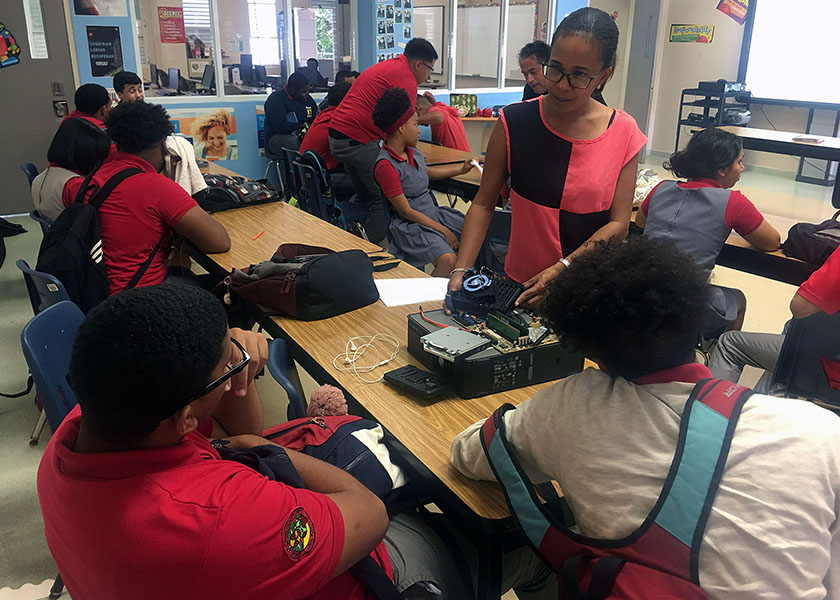
[/media-credit] Nilka Modesto teaches computer science to students in a classroom at Superior Vocational High School in Loíza, Puerto Rico. Use of the computer lab next door to their classroom is limited due to frequent blackouts after Hurricane Maria. (Tatyana Hopkins/NNPA)
The Superior Vocational High School in the small coastal town of Loíza is an example of the ongoing struggles of public education across the island.
After Hurricane Maria hit the island in September, the school reopened its doors last November, but promptly closed again.
“In November, we had classes just one week with a generator, then closed again until January because the generators kept shutting off,” said the school’s principal, Doris Villaran.
Gas-powered generators are being used across the island to supply electricity.
Superior Vocational suffered little structural damage, she said. It has been opened for a full three months now. Still, some things are not as they were before the storm. The school now operates on a shortened schedule, without running water or air-conditioning. Students use the school’s Microsoft Showcase computer equipment sparingly for fear that the island’s regular blackouts could ruin them.
Still, Superior Vocational is running better than others in the Humacao school district, which includes schools on the island’s east coast.
“The hurricane came directly through this region,” said Sol Ortiz Bruno, the Humacao school district’s regional director of education.
Loíza, where Bruno was spending the day, sits in a tsunami zone and gets hit by seasonally high waves from the ocean. The waves can flood the area, because of its low elevation. Two weeks earlier, the city was hit by heavy waves that caused flooding and closed the school for a few days, Bruno said, as she met with maintenance workers about damage to the building.
“And today we are preparing for tsunami season,” she said.
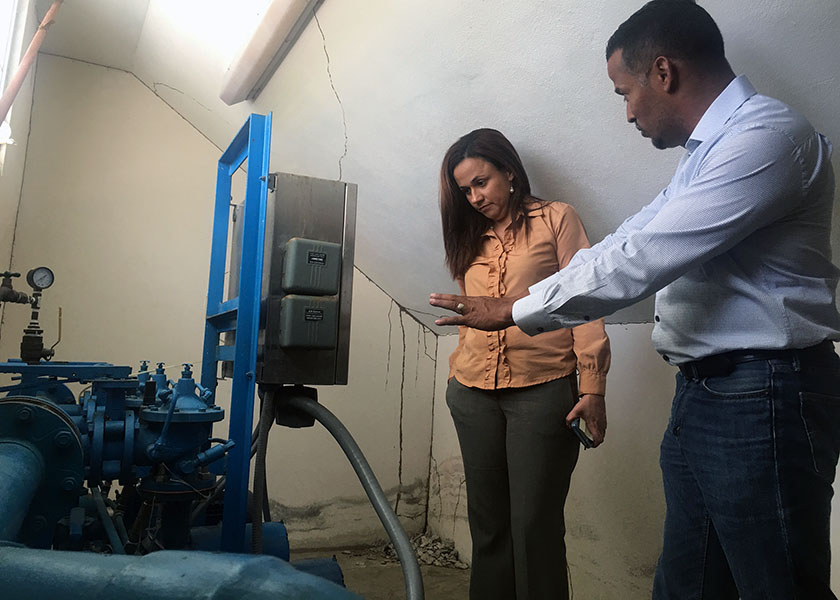
[/media-credit] Humacoa School District Director Sol Ortiz Bruno (left) and the area’s Public Building Authority Director Emmanuel Hurtas examine the water system Superior Vocational High School, in Loíza, Puerto Rico. (Tatyana Hopkins/NNPA)
Bruno said that neighboring towns in the island’s central mountain ranges, like the municipalities of Humacao and Caguas, were hit worse. The Humacao school district consists of 17 towns. At least 4,600 students of its 43,000 students either moved to the United States or other areas of Puerto Rico after the hurricane. Two of Superior Vocational’s teachers also left after the hurricane. Including the other 10 schools in Loíza, at least 1,200 of the town’s students moved away.
“We lost the most students of any other region,” she said.
Of the school district’s 159 schools, 88 are fully operational with electricity from the city’s power supply. Fifty-three schools do not have electricity; 14 run on electricity from generators provided by the federal government, two are closed temporarily, because of structural damage and two are permanently closed.
“The school is open, everyone is here and doing what they’re supposed to do, but it is hard being here when nothing is working,” Superior Vocational Principal Villaran said.
Superior Vocational offers six trades, nursing, business administration, computer information, culinary arts, marketing and barbering. Teachers have had to adjust their curriculum, because of limited facilities.
One of the big problems is a lack of air-conditioning in an area where temperatures top 90 degrees, usually by noon. Hurricane Maria ruined the school’s rooftop air-conditioning system, forcing the school to alter its hours to compensate for the heat. Students normally attended school from 8 a.m. to 3 p.m., when the school had air conditioning. Now, they go from 7:30 a.m. to 12:30 p.m., because the temperature is too high.
“When the computers are off, you can feel the heat,” said computer science teacher Nilka Modesto. “So, imagine how it would feel with them on.”
Modesto said that, because the power outages have limited use of the school’s computers, her instruction has moved from hands-on practice learning to theory.
“I can’t teach the normal way, because of the heat and lack of Internet,” Modesto said.
Lack of Internet access has also left the school’s phones out of service, forcing staffers to use their personal cell phones.
Blackouts have also damaged the school’s electric-powered water system meaning students in barbering classes cannot use in-classroom sinks to wash hair. Instead, they go downstairs to use the bathroom’s makeshift sink.
To compensate for the failed water systems, school administrators have connected three 100-foot water hoses to a main water line to fill bins in the buildings restrooms, so students can wash their hands and to flush the toilets.
“Then we take the same hose and run it to the kitchen, where we use it to wash the dishes,” Villaran said. “We use bottled water for cooking.”
The only other option would be to share a more functional building with another school where one group would go to school for five hours in the morning, and the other group attend classes for five hours in the afternoon, Villaran.
“That’s more complicated than filling the cans with water, and that’s why we stay here,” Villaran said. “We are just waiting for someone to come fix this.”
But, that could take a while.
“The schools don’t get dedicated funding, and after Maria we have to go through the local and federal government,” Bruno said. “We don’t have the money and we have to wait for it to be approved. They make us wait and the process is really slow.”
Emmanuel Hurtas is the director of the Puerto Rico Public Buildings Authority (PBA) for the Humacao school district.
He is responsible for 50 schools in the Humacao school district.
Hurtas said that he must weave his way through a three-part bureaucracy to get needed repairs done.
The first agency approves the project, the next buys the equipment and the last evaluates the purchases before giving the final approval to begin work.
He said the process could take up to the three weeks for a simply request.
Puerto Rico’s legislators have introduced school reforms that they say will revamp the underperforming school system and cut costs. It includes closing schools with less than 150 students; there are 300 of them on the island. They also have proposed introducing charter schools to the island. Teachers and PBA employees opposed the plan.
Puerto Rico’s Board of Education has announced it plans to repair schools damaged by Hurricane Maria, Bruno said, but, so far, it hasn’t issued a date for its implementation, largely, because it has no money.
Consequently, Bruno said, “They make us wait. The process is really slow.”
Through it all, students in Loíza remain optimistic.
“Things are different at the school, but I don’t see a difference in the way I am being taught,” said Doralys Delvalle, 17, a senior nursing student at Superior Vocational whose family lost the roof of their home to the hurricane. “I’m excited to graduate soon.”
Featured
Inspired by the Black Panther Party and the Young Lords, Puerto Rican Activists Launch Centro De Apoyo Mutuo
Inspired by the Black Panthers and The Young Lords, Centro De Apoyo Mutuo, a group of community activists in Caguas, Puerto Rico offer aid to residents in need. Centro De Apoyo Mutuo (CAM) means Center for Mutual Help.
By Tatyana Hopkins (NNPA Newswire Special Correspondent)
CAGUAS, Puerto Rico—The last thing you would expect to find in the central mountain range of Puerto Rico is the influence of the 1960s Black Panther Party. But there it was.
The tenets of the revolutionary group, founded in 1966 in Oakland, Calif., by Huey Newton and Bobby Seale, were mixed with stewed pork chops, rice, beans and healthcare on a 90-degree winter day, 20 miles south of San Juan in the city of Caguas.
Volunteers with Centro De Apoyo Mutuo (CAM) prepared meals and provided services to residents in an abandoned building “rescued” by a group of local activists.
Black Panther Principle No. 4: “We Want Decent Housing Fit for The Shelter of Human Beings.”
Emilu Berrios moved through the kitchen and then out to the clinic area, all the while making clients comfortable and seeing to their needs. Berrios is co-founder of the Centro De Apoyo Mutuo (CAM) and she made it abundantly clear what drives her and the organizers.
“We are influenced by the Black Panther Party and the Young Lords,” she said. The Young Lords was a lesser known Puerto Rican organization that launched in Chicago in 1968 that became a national civil and human rights movement in nearly 30 cities.
Daniel Orsini, another co-founder, explained the connection.
“The Young Lords saw the Black Panthers trying to get justice for Black people, and they knew they needed to do the same thing,” Orsini said.
Black Panther Principle No. 9: “We Want Land, Bread, Housing, Education, Clothing, Justice and Peace.”
Centro De Apoyo Mutuo (CAM), which translates in English to the “Center for Mutual Help,” is the brainchild of a group of Puerto Rican activists, who have modeled their efforts on the service portion of the Young Lords and the Black Panthers.
While the groups were known for their radical tactics—the Black Panthers encouraged Black Americans to police their own neighborhoods carrying loaded firearms—they also introduced numerous service efforts to aid Black and Puerto Rican communities, like the free breakfast program that was eventually emulated in America’s schools. The Panthers started the breakfast program first and the Young Lords followed their lead.
Centro started by serving food to those left destitute following Hurricane Maria, which smashed into the island and left historic destruction in its wake. Homes, government buildings, hospitals and other facilities were destroyed. When the center started its work, running water was unavailable. The vast majority of the island was without power and some residents still are, six months later.
Today, the center serves 150 meals—breakfast and lunch—every Monday, Wednesday and Friday.
But the food is not free, Berrios said.
“Here, we operate on solidarity, not charity,” she said. “That means in order to get something, you must give something.”
Recipients of the center’s health, food and social services can pay for them in three ways: money, donations of food that the organization uses to make meals or by volunteering their time at clinics and by restoring the group’s building.
The center is located near the town’s center in a former social security building that had been abandoned for 30 years. The group took over the building, shortly after the storm.
“Our building is a ‘rescued’ building,” Berrios said. “I say ‘rescued.’ We don’t say ‘occupied.’”
The facility’s purpose now, she said, is “the complete independence of the people from the government.”
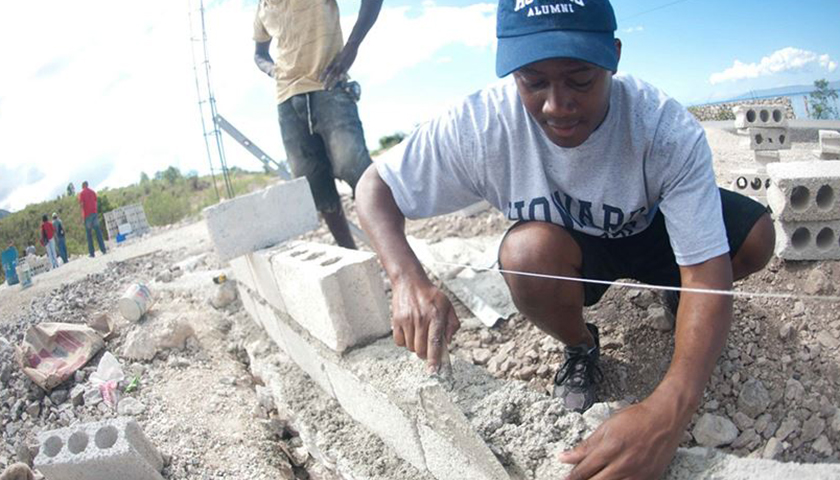
The organization is still repairing the long-vacant building. A group of Howard University students with the school’s Alternative Spring Break program were there to help. The students scraped peeling paint, cleared trash and helped prepare meals.
On Tuesday, March 14 the students traveled 90 minutes from their campsite in Arecibo to Caguas, a city of 136,000 located in the largest valley in Puerto Rico. Caguas is known across the world as the home of the Criollos de Caguas baseball team, considered one of the greatest squads in all of Latin America, has won more than a dozen Puerto Rican national titles and five Caribbean World Series titles
Rescue and recovery efforts in the Caguas were hindered by its size and location.
“Federal and local government efforts were slow,” Orsini, 36, said. “Within eight days after Maria, we were serving the community.”
Nichole Villegas, 26, whose home is two blocks away from the center, said she was without electricity and other power for about two months. Some days, she said, the center served the only meal she ate.
“After Maria, they started serving food, and so, I started coming here to eat,” Villegas said. Since the hurricane, she said, she has eaten lunch at the center every day it is open, because she does not have enough food at home.
Carmen Cruz, 48, comes to eat three times a week, as well. Cruz, who lives in the mountains, said she didn’t have electricity until March 5. Sometimes she walks to town, which takes an hour. Other times, she gets a 15-minute bus ride. She came initially for the food, she said.
“I didn’t have lights,” Cruz said.
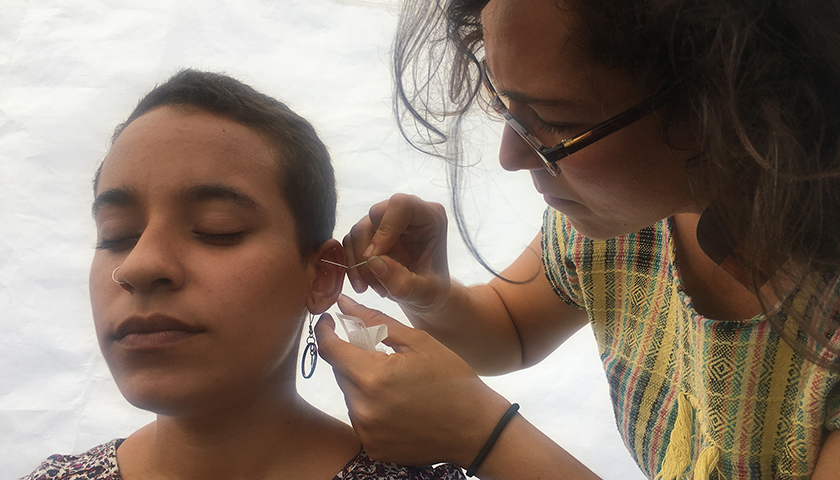
Now, she and others come for something the Young Lords and the Black Panther Party also offered—acupuncture. The groups introduced what they called “liberation” acupuncture in 1970 when they founded the Lincoln Detox Center in the South Bronx in New York City after occupying part of Lincoln Hospital. They provided acupuncture that focused on points on the ear to help drug users overcome their addictions. They also opened a school to teach the medical technique, which was developed in China, for treatment of a variety of other ailments.
Centro, following the example set by the Panthers and the Lords, offers the same acupuncture care.
“Acupuncture is not a part of our culture,” Orsini said. “It’s a new idea to us. When we get sick, we go to the hospital and get chemicals that we call ‘medicine.’”
Villegas now comes every Tuesday to receive acupuncture to treat hip and back pain. The treatment is only offered on Tuesdays.
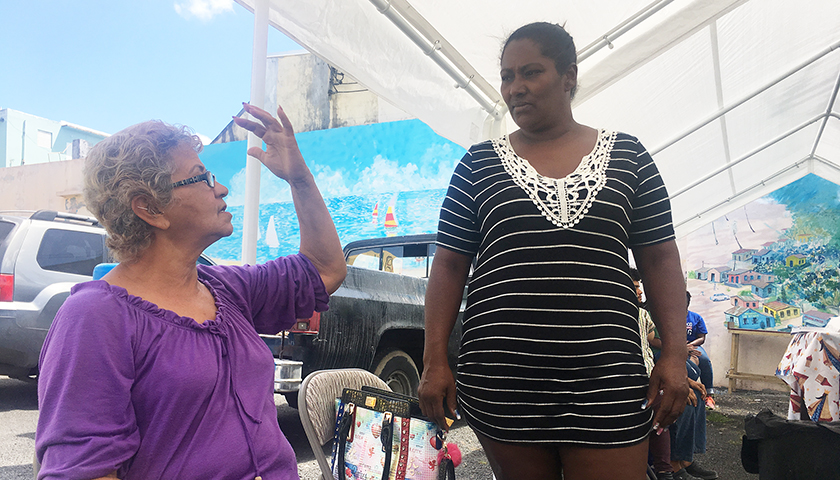
[/media-credit] Carmen Cruz (right), 48, talks to another acupuncture patient following her treatment at the Centro De Apoyo Mutuo (CAM) in Caguas, Puerto Rico. (Tatyana Hopkins/NNPA)
“I don’t like pills and medications,” she said. “Before this, I used marijuana [for pain].”
Since Villegas started acupuncture, she said, she’s in less pain and sleeping better. Cruz is also getting acupuncture at the center.
“I started last week to treat depression and pain.” she said. “I already see a difference, and I am sleeping through the night. I will be here every Tuesday”
The founders of the center hope it will become a community space for activists, protestors and organizers to mobilize their efforts and spark a new movement among Puerto Ricans that will hold their government accountable, as well as become less dependent on the federal government.
Puerto Rico is a protectorate of the United States. Though its residents are citizens, they cannot vote, nor do they have representation in Congress. Some Puerto Ricans have called on independence from the U.S.
“We don’t want to need anything from the [federal government], because they have failed to meet our needs,” Berrios said.
Berrios and other Centro members argue that the island’s dependence on the federal government has made it unable to meet the needs of its citizens.
Kevin Ortero Rivera, 19, who goes to the center, daily, agrees with the organization’s philosophy. He only received electrical power a month ago, and his family in Thomas de Castro, still does not have electricity, he said.
Rivera added: “Whether we are a state or not, we need to come together and do something for ourselves.”
National
Howard University Students Rebuild, Mentor in Puerto Rico for Alternative Spring Break
HBCU students with Howard University’s Alternative Spring Break program help to rebuild La Hermosa Church in Arecibo, Puerto Rico. In September 2017, Hurricane Maria, a Category 5 storm, ravaged the island affecting the lives of millions of Americans.

By Tatyana Hopkins (NNPA Newswire Special Correspondent)
ARECIBO, Puerto Rico—When Howard University student Jasmine Stevens fled New Orleans in 2005 to avoid Hurricane Katrina, she left with just enough clothes for two days. The Category 3 storm would cover her family’s neighborhood in eight-feet of water, destroy their belongings and force them to abandon their home and flee to Port Arthur, Texas, where they remained for three years.
“We lost everything,” Stevens, 20, said. “It didn’t hit me until I watched the news and saw my city underwater.”
Now, Stevens, a junior biology major, finds herself in a familiar spot, but this time hundreds of miles away in Puerto Rico, where another hurricane has wreaked havoc on the lives of millions of Americans.
Stevens is here with fellow Howard students to help the people still recovering from Hurricane Maria, which six months ago destroyed thousands of homes, wiped out the island’s already out-of-date electric grid, and limited access to clean drinking water for millions.
Most of the island now has electricity and water, but the restoration of destroyed homes, businesses and churches continues.
Stevens and six other Howard students spent Monday rebuilding La Hermosa Church in downtown Arecibo, a town of 96,000 on the island’s northern coast. Stevens, who is participating in Howard University’s Alternative Spring Break (ASB) program, traveled to Puerto Rico during her spring break to assist in recovery efforts.
The students in Puerto Rico and more than 700 other Howard students have given up their vacation week, the parties and trips home to help people in various distressed areas, including Haiti, Anguilla, St. Martin, St. Thomas, Flint, Mich., New Orleans, Chicago, Texas and Florida.
“I believe that, as a global citizen, it’s important to help those in need,” said Ngodoo Iye, 21, a senior on her third ASB trip.
Stevens echoed those sentiments.
“For me, this trip is a way to give back to those who helped my family when we were victims of Hurricane Katrina,” Stevens said.
Once a place of worship for a congregation of about 40 people, La Hermosa Church remains without power and running water. After the storm, the 12,000-square foot, one-story building church was submerged in at least eight-feet of water, said La Hermosa’s pastor, Miguel Asegarra.
“I was outside watching the hurricane, and it never touched my home,” Asegarra said, “but it destroyed our church.”
Asegarra has led the church for two years. He lives 15-minutes away in a residential neighborhood.
La Hermosa rests in the city’s downtown, which was flooded by the Rio Grande Arecibo, a river just blocks away.
“This is one of the oldest churches in this city and we lost everything,” Asegarra said. “But, God has blessed us, because many people have come to help us.”
The Howard students picked up restoration of the church where several other groups left off. The church, once covered in mud and debris, had been cleaned and gutted by previous groups. The ASB team was tasked with repainting the church’s walls.
The church was one of dozens of buildings—businesses, homes, schools, government offices—that were severely damaged in Arecibo, which lies about an hour and a half west of the capital city of San Juan.
Irma Sierra Cordova, owner of a downtown pharmacy, said she used her savings to re-open her business, which closed for two months.
“I lost all of my inventory,” Cordova said, “but homes should be the priority.”
Others are still repairing homes ripped apart by the fierce winds of the storm.
“I lost my whole roof, and I have a blue tarp on top of my house to prevent it from leaking [when it rains],” said Roberto Valez, 68, a Puerto Rican native who retired here after 30 years working construction in New London, Conn. “In the first month, rain would get in and damage everything.”
While Stevens’ team worked on the church, other Howard students helped restore a building in nearby Dorado. A third group visited the local Boys and Girls Club in Las Magaritas, a neighborhood in San Juan. While there, they tutored older students and danced and played hide-and-seek with the younger ones. They taught the kids the “Cha Cha Slide” and the students taught them salsa.
Pastor Humberto Pizarro of Connected Life, a ministry in San Juan, helped Howard’s ASB program connect with those most in need. Pizarro’s church organization, Shining Bright International, is a missionary and outreach ministry that has helped more than 40 teams from the United States and the Caribbean work more than 240,000 volunteer hours to restore the island.
“God has trained us for this, and we hit the ground running,” Pizarro said.
Within two days after the hurricane, his church began delivering meals, fuel and water to residents, and by the end of the week, they had flown in their first group of helpers from the U.S. mainland.
“Everyone in our church is trained to respond to these [types] of disasters,” Pizarro said. “The church is a temple to worship, but [the church’s mission] happens outside of its four walls. We focus on outreach.”
Howard student Audre’ana Ellis said she was impressed with the work Pizarro’s church had done to move recovery efforts along.
“I’m excited to help and serve,” Ellis, 18, said. “I’m surprised to see that everyone here is so strong and has come together to get through this.”
Education
Howard Student, Dallas Native Experiences Healthcare in Puerto Rico, Firsthand, during Alternative Spring Break
NNPA Newswire Special Correspondent Tatyana Hopkins reports on recovery efforts on the island of Puerto Rico. Hurricane Maria devastated the island, last September.
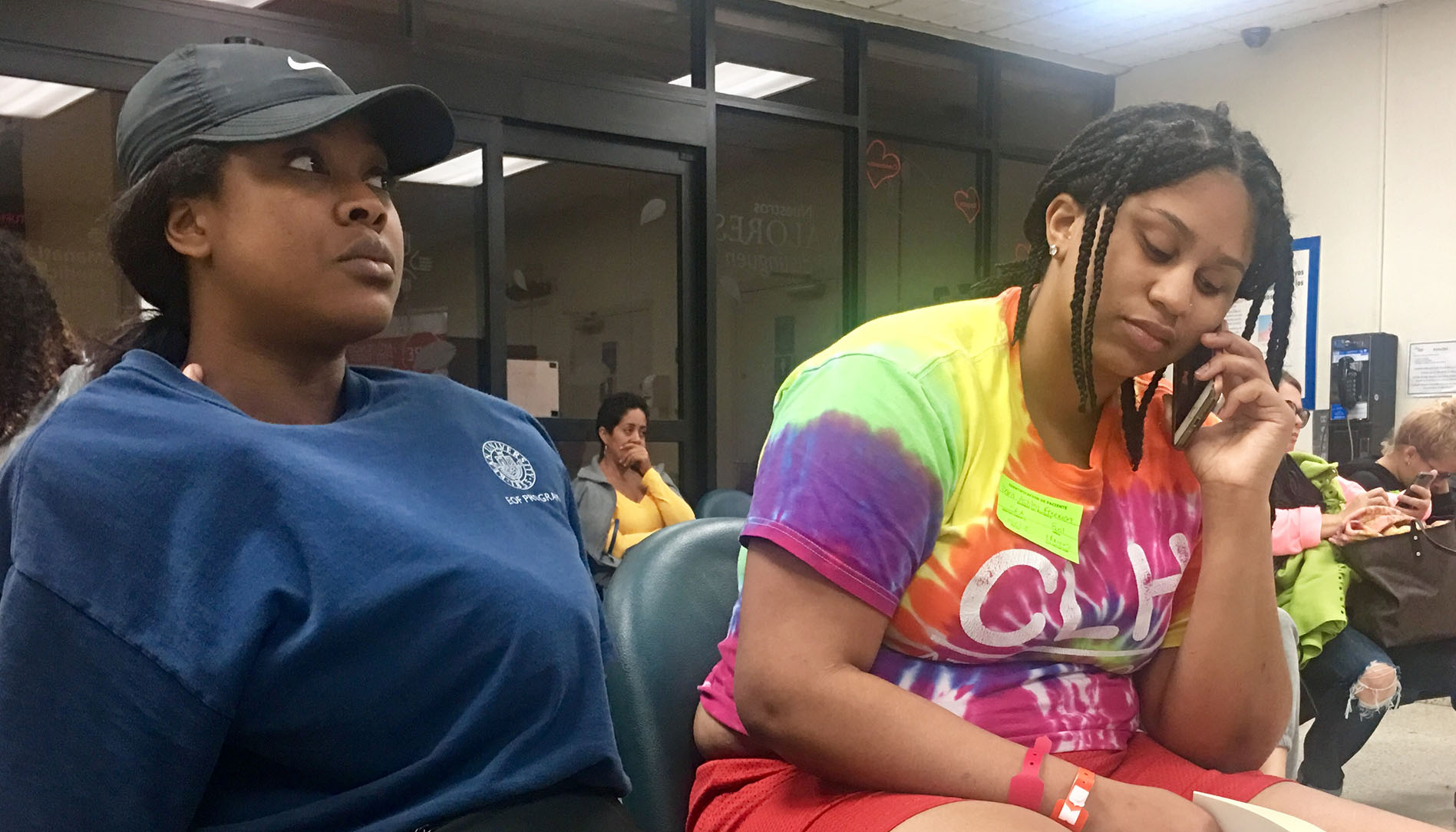
By Tatyana Hopkins (NNPA Newswire Special Correspondent)
MANATI, Puerto Rico—Howard University student Dara Freeman, was in pain, crazy pain, the kind that most people will never experience. Freeman, 20, had been hit with a migraine headache.
The pain is excruciating, so severe that it has caused high-profile athletes, like basketball stars Dwayne Wade, Kareem Abdul-Jabbar and Scottie Pippen—to miss championship games, because they simply couldn’t play through the torment.
According to the Migraine Research Foundation (MRF), a nonprofit group that raises money to support research and improve treatments for migraines, “Every 10 seconds, someone in the U.S. goes to the emergency room complaining of head pain and approximately 1.2 million visits are for acute migraine attacks. Healthcare and lost productivity costs associated with migraines are estimated to be as high as $36 billion annually in the U.S.”
The group’s website also noted that three times as many women as men suffer from migraines in adulthood.
Freeman tried to describe the pain between breaths.
“It feels like someone is trapped in my head and is trying to kick their way out,” she said.
Now, the Dallas native, who had accompanied dozens of Howard students to Puerto Rico to help the residents of the hurricane-stricken island, was in desperate need herself.
Freeman needed a hospital, so a friend and Howard University faculty adviser Silvia Martinez drove 20 minutes east from the Assemblies of God Campsite in Arecibo, where the students are staying, to Manatí.
The first Manatí hospital that the group took Freeman to looked closed, even though it wasn’t. In the confusion, the students left and drove to another hospital; that hospital appeared closed, too.
Freeman, a junior, began to worry that she would not receive treatment.
The group ended up at the Manatí Medical Center, where Freeman said that she received the same level of care that she would have received in a hospital emergency room in her hometown.
Nurses quickly got her in and out of triage. Physicians and technicians placed an intravenous needle into her arm, conducted blood tests, and gave her a shot for the pain. They gave also her medication for allergies that can cause the headaches.
She arrived at the hospital at 9 p.m., received treatment and slept until about 7 a.m. the next morning. She woke up drowsy and confused.
“When I woke up, I was a little startled and I almost punched a nurse,” Freeman said. “I thought they were trying to steal me, but then I realized I was okay.”
Freeman was fortunate that she hadn’t needed help in the weeks right after Hurricane Maria hit the island last September. The brunt force of the near Category 4 storm hit Manatí, a town of 43,000 residents on the northern coast of Puerto Rico. After viewing the destruction of his city, the town’s mayor, José Sánchez, called the area a “no man’s land.” He pleaded with the Puerto Rican government for aid more than a week after the storm.
For weeks, the town went without power and water. Residents used rainwater collected in a local swimming pool and hospitals were left without resources to treat patients.
“We did not have power and we were on generators for a while, until about November or December,” said a switchboard operator from the hospital just a few blocks from where Freeman was treated. She declined to give her name. “Now, we [have power], and there are changes that have been made, but we’re still open.”
Hospitals on other parts of the island ran low on medications. Treatment centers for chronically ill patients decreased, and many of the island’s medical professionals did not report to work.
Conditions have certainly improved, residents said.
“This is one of the best hospitals,” Carlos Montallzo, 41, said as he waited near the Manatí Medical Center emergency room. Montallzo was there to get his 17-year-old son treatment for a severe nosebleed.
According to information released by the government, all of Puerto Rico’s 67 hospitals are operating. Meanwhile federal recovery efforts have reached at least 38,000 people who were without needed healthcare and got them to appropriate healthcare facilities.
Ruth Barosy, 39, is a visiting family medical resident from New York City working at the Mayagüez Medical Center, a hospital on the west coast of the island, about two hours from San Juan, the island’s capital.
In the immediate aftermath of the hurricane, Barosy said that the hospital transferred patients to other facilities and then shutdown due to lack of power and extensive damage to its roof. It re-opened weeks later, but limped along sparingly on generators and experienced several power failures.
“We lost a few patients, but compared to other places, we didn’t get it that bad,” Barosy said. “San Juan got [hit] the hardest. Now repairs are complete and we are back.”
Other areas still need help, she said.
“San Juan still experiences power failures, and I wouldn’t be surprised, if there were still communities without access to healthcare,” she said.
Barosy said her hospital staff reached out to rural communities, who struggled with health access, even before the storm, and were even more desperate afterwards.
“In the metro area, things are running like normal,” she said. “Then, there are places that don’t have anything.”
Natali Rivera, 29, a missionary with the outreach group Assemblies of God, said that, even now, sick people in rural areas on the island are still in great need of medical attention. She said that her church, Connected Life, has run health clinics in many of the island’s rural communities.
“It’s hard to get food and supplies to people in the mountains, because it’s hard to use the roads, but they are still in need,” Rivera said.
Meanwhile, Freeman spent Sunday back in the camp in Arecibo recovering, while other students attended church in San Juan. She said she wanted to be ready for Monday, when students begin their work with hospitals and schools.
Education
Howard University Heads to Puerto Rico to Help: Students Give Up Spring Break to Help in Recovery Efforts
Howard University students will travel to Puerto Rico to help in Hurricane Maria recovery efforts as part of the university’s Alternative Spring Break program.


NFL: Week Two Recap | Jalen Hurts did not fold; Caleb Williams exits game with injury

The Complete Negotiation Framework — Every Stage, Every Tactic, Every Win

Mazda CX-90 Luxury: Heated Seats & Premium Comfort! #shorts

Car Dashboard Glare: Avoid This Distraction! #shorts

Mazda CX-90 Safety: All Driver Assistance Features Explained #shorts

Subaru Outback: 19-Inch Wheels & 8.8″ Ground Clearance! #shorts

Unlock Car Deals: Avoid Hidden Costs & Negotiate Smarter #shorts

Event Preview: ‘Fashion v. Fascism’ – A Runway Revolution Is Coming to the Bay Area

Harman Kardon Sound & Luxury Outback: Smooth, Quiet Ride #shorts

Mazda’s 3.3L Turbo Engine: Power & Tech Explained #shorts

You Had Me at Hello: the Love and Legacy of Grace Nail and James Weldon Johnson

Arnold Perkins: At 85, a Life of Service, Faith and Giving Back

Young Black Men Suffering in Silence A curse that can be Broken

Young Black Men Suffering in Silence A curse that can be Broken

Women Learned Their Jail Strip Searches Were Recorded. Their Outrage Changed the Law

🎷 Jazz is taking over D.C.!

BSPNTX Announces 2026-27 Scholarships Recipients

Black Americans Have Doubts About the U.S. Food System

Barbados – Julius Garvey, Son of Marcus Garvey, Joins PM Mottley in the Rededication of the Garvey Amphitheater

IN MEMORIAM: Dolly Parton Dead at 80 — How She Built a Legacy of Love and Earned Her Place in Black Culture
The Complete Negotiation Framework — Every Stage, Every Tactic, Every Win
Mazda CX-90 Luxury: Heated Seats & Premium Comfort! #shorts
Car Dashboard Glare: Avoid This Distraction! #shorts
Mazda CX-90 Safety: All Driver Assistance Features Explained #shorts
Subaru Outback: 19-Inch Wheels & 8.8″ Ground Clearance! #shorts
Unlock Car Deals: Avoid Hidden Costs & Negotiate Smarter #shorts
Harman Kardon Sound & Luxury Outback: Smooth, Quiet Ride #shorts
Mazda’s 3.3L Turbo Engine: Power & Tech Explained #shorts

Live from CBC

Live from CBC 📱
-
 Black History7 days ago
Latest Massacre in Haiti Reveals Cruelty U.S. Deportations
-
 Black History1 week ago
Booked and Unbound: The Legacy of Black Women’s Literary Circles
-
 Black History7 days ago
Henry O. Flipper: A Trailblazer at West Point and Beyond
-
 Black Press7 days ago
Asm. Smallwood-Cuevas’s Bill Repealing ‘Racist’ CalWORKs ‘Man-in-the-House’ Rule Clears Legislature
-
 Black History7 days ago
OP-ED: If AI Is the New Language of Power, Then NAN Wants Black Communities Fluent
-
 Black Press7 days ago
California Legislature Sends Historic Native American Apology Bill to Gov. Newsom’s Desk
